












01
Never miss a reappointment
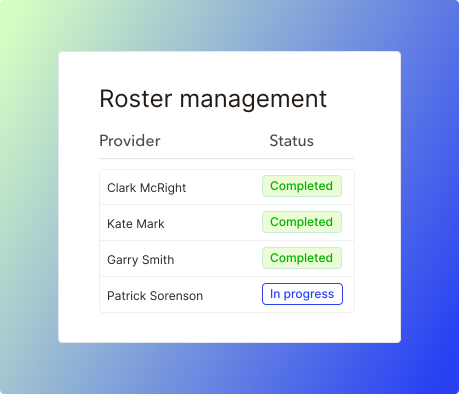
Automated workflows stay ahead of expiration cycles and prevent lapses.

Privileging
Providers approved and practicing with less friction — automated workflows, AI-assisted form completion, and built-in compliance support handle privileging from request intake to committee review.
Request a meeting













AI-assisted verification workflows with expert review ensure every privileging file meets regulatory requirements before it reaches committee.
Automation-powered workflows collect and assemble provider data, applications, and supporting documents — with expert review ensuring every packet is accurate before approval.
Help committees review providers with less friction — manage serial or parallel committee approvals with built-in notifications and single-click approve or reject workflows.
Full visibility into provider status, requirements, and approvals — tracked from a single system across your enterprise.
Automated workflows stay ahead of expiration cycles and prevent lapses.

Medallion maps data into hospital-specific forms, submits, and follows up until privileges are granted.

Bylaw-driven PSVs and auto-assembled, committee-ready files.

Hospital privileging is the process by which a hospital’s governing body formally authorizes a provider to perform specific clinical services within that facility — such as admitting patients, performing surgeries, or ordering treatments. Privileging is distinct from credentialing: credentialing verifies a provider’s qualifications, while privileging determines what they’re authorized to do based on those qualifications. Both must be completed before a provider can practice, and both require ongoing monitoring and renewal cycles to maintain compliance with NCQA and The Joint Commission standards.
Credentialing and privileging are sequential: a provider cannot be granted hospital privileges until their credentials have been verified. The credentialing process — primary source verification of licenses, training, malpractice history, and certifications — feeds directly into the privileging decision made by the medical staff and governing board. Delays or errors in credentialing directly delay privileging, which means providers can’t see patients or generate revenue. Medallion accelerates both processes to keep privileging decisions moving without rework.
A provider may lack hospital privileges for several reasons: incomplete or expired credentialing files, a lapse in licensure or malpractice coverage, unresolved items in their NPDB history, or failure to complete the privileging application itself. Resolving it requires identifying the specific gap, gathering updated documentation, and resubmitting through the hospital’s medical staff office — a process that can take weeks without the right infrastructure. Medallion’s monitoring flags credential and license issues before they create privileging delays, so organizations can resolve gaps proactively rather than reactively.